Home
» AI News
»
Anthropic Claude Fable 5.1 and Mythos 5.1: What Changed, Pricing, Safeguards, and What AI Users Should Know
Anthropic Claude Fable 5.1 and Mythos 5.1: What Changed, Pricing, Safeguards, and What AI Users Should Know
Updated September 10, 2026: Anthropic released Claude Fable 5.1 and Claude Mythos 5.1 on September 1, 2026. The most important point is easy to miss: they are the same underlying model, but they are offered with different safeguard and access policies. Fable 5.1 is the broadly available version for paid Claude users and developers, while Mythos 5.1 is restricted to vetted organizations working in areas such as cybersecurity and life sciences.
The release is not simply a benchmark refresh. Anthropic changed prompt-cache economics, refined safety filters that had caused false positives, added new API behavior for long-running agents, strengthened anti-distillation measures, and outlined a new enterprise safeguard architecture. For anyone deciding whether to switch models, the practical questions are therefore about workload fit, total cost, access rules, and integration changes—not just which model posts the highest score.
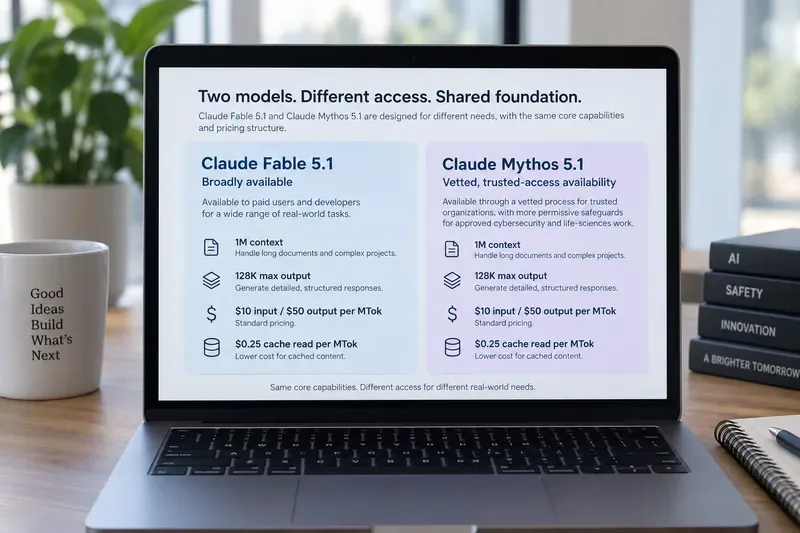
AI-generated illustration of the Fable 5.1 and Mythos 5.1 relationship. It is not an official Anthropic product screenshot.
What exactly are Claude Fable 5.1 and Claude Mythos 5.1?
Anthropic describes Fable 5.1 and Mythos 5.1 as the same core model with different levels of safeguards. Fable 5.1 is intended for general paid access, coding, knowledge work, research, and long-horizon agentic tasks. Mythos 5.1 exposes more permissive safeguards for approved cybersecurity and life-sciences users through trusted-access programs. That means Mythos is not a separate “smarter” model in the usual sense; the difference appears when Fable’s safety layer blocks, redirects, or limits a task that an approved Mythos user is allowed to perform.
Both models have a 1 million-token context window, a maximum output of 128,000 tokens, text-and-image input with text output, and always-on adaptive thinking. Anthropic lists a June 2026 reliable knowledge cutoff and says the models default to high effort through the API. The company’s official Fable 5.1 model documentation is the best source for current specifications and platform support.
What changed from Fable 5?
The headline improvement is stronger performance on long-running work. Anthropic says Fable 5.1 improves agentic coding, multistep research, document work, spreadsheets, slides, and sustained problem solving. Its launch benchmarks also show gains over Fable 5 on several Anthropic-reported evaluations, including Terminal-Bench 4.0, AutomationBench, CursorBench, and OSWorld 2.0. Those numbers are useful signals, but they should not replace testing on your own tasks because benchmark harnesses, safeguards, tool access, and effort settings can materially change results.
For developers, several concrete integration changes matter more than the marketing headline. According to Anthropic’s Claude Platform release notes, Fable 5.1 and Mythos 5.1 no longer support forced tool-choice modes any and tool; those requests return HTTP 400. The supported auto and none modes are unchanged. Anthropic also changed how thinking blocks can be replayed: earlier Claude models cannot read thinking blocks produced by 5.1, and for new API accounts, editing earlier conversation history before a thinking block can cause the request to be rejected.
At the same time, 5.1 adds beta features aimed at agent workflows: per-message effort changes, turn-scoped system messages, user-visible progress updates between tool calls, and content provenance. Existing prompts written for Fable 5 should generally continue to work, but production integrations should still run regression tests before changing the model ID.
How much do Fable 5.1 and Mythos 5.1 cost?
Base token prices did not change from Fable 5. Both Fable 5.1 and Mythos 5.1 are priced at $10 per million input tokens and $50 per million output tokens. The major pricing change is prompt caching: cache reads dropped from $1 per million tokens on Fable 5 to $0.25 per million tokens on Fable 5.1—a 75% reduction.
Usage type
Fable 5.1 / Mythos 5.1 price
Standard input
$10 per million tokens
Output
$50 per million tokens
5-minute cache write
$12.50 per million tokens
1-hour cache write
$20 per million tokens
Cache read
$0.25 per million tokens
Batch API
50% discount on standard input and output
Anthropic estimates that the lower cache-read rate can reduce the cost of typical Fable workloads by about 25% and highly agentic, context-heavy workloads by as much as roughly 45%. That estimate is not a guaranteed discount for every application. The benefit depends on how much of each request can actually be served from cache. Applications that repeatedly resend large stable prefixes—long system prompts, tool definitions, repository context, or growing agent transcripts—stand to gain the most. The current rates and caching multipliers are documented on Anthropic’s official pricing page and prompt-caching documentation.
Is Fable 5.1 automatically the best-value Claude model?
No. Fable 5.1 is a premium model, and its standard input and output rates are twice those of Claude Opus 5, which Anthropic currently lists at $5 per million input tokens and $25 per million output tokens. Fable 5.1’s unusual advantage is that its cache reads cost $0.25 per million tokens, half the $0.50 cache-read rate of Opus 5. A deeply agentic workload with a very high cache-hit ratio can therefore have a different cost profile from a short chat or one-shot generation task.
Anthropic’s own model guidance says most workloads should start with Opus 5, then move to Fable 5.1 for demanding reasoning and long-horizon agentic work or when higher-effort Opus 5 evaluations still fall short. That is a sensible decision rule: do not pay for Fable 5.1 simply because it is newer. Measure task success, latency, output-token use, cache-hit rate, and cost per completed task.
Who can use Fable 5.1, and who can access Mythos 5.1?
Fable 5.1 is available through the Claude API and major Anthropic deployment channels including Amazon Bedrock, Google Cloud, Microsoft Foundry, and Claude Platform on AWS. Anthropic also says Fable models are available on paid Claude plans, although the way usage is billed or counted differs by plan. For example, the company’s Fable plan-access help article says Pro users and some standard seats use pay-as-you-go usage credits, while Max and certain premium seats can use Fable within part of their weekly limits. Fable is not available on the Free plan as of this update.
Mythos 5.1 is much more restricted. Anthropic says it is available to vetted cyberdefenders and life scientists through trusted-access programs. As of September 10, 2026, the company says access is limited to a set of U.S. organizations while it works to broaden domestic and international availability. The Cyber Verification Program is expected to add Mythos-class access, and the Life Sciences Verification Program is being expanded for approved professional research. Current access details are summarized on Anthropic’s official Mythos page.
How did the safeguards change?
Anthropic’s safety strategy is central to the Fable/Mythos split. Fable 5.1 keeps stronger restrictions for high-risk cybersecurity and biology tasks, while Mythos 5.1 can provide more permissive access to vetted professionals. The company says the new Fable safeguards are more precise than the original Fable 5 controls.
For cybersecurity, Fable 5.1 now permits vulnerability discovery in source code, which is useful for defensive review. Anthropic says Claude Code users should see about 60% fewer safeguard interventions per session than with the previous Fable 5 cyber safeguards. However, several dual-use activities—including penetration testing, exploit generation, and binary-based vulnerability scanning—can still be redirected to Opus models rather than handled by Fable 5.1.
For biology, Anthropic says its updated safeguards fire 85% less often on benign elementary-biology and medical requests than the safeguards that originally shipped with Fable 5. More advanced life-sciences research and development can still be routed away from Fable to Opus models. Mythos 5.1 provides a separate trusted route for approved researchers who need the more capable life-sciences behavior.
Anthropic also reports stronger anti-distillation controls intended to make large-scale extraction of model capabilities more difficult. One associated API change prevents new accounts from modifying earlier conversation context while preserving prior thinking transcripts in the same way that some distillation techniques relied on. In addition, Fable 5.1 and Mythos 5.1 outputs carry Anthropic’s text watermark, while supported media produced through code execution can carry C2PA Content Credentials. Anthropic describes these deployment and safety decisions in its September 2026 launch announcement and lists the accompanying Fable 5.1 and Mythos 5.1 system card.
What should enterprise users know about data retention?
Do not assume that using Fable 5.1 automatically means zero data retention. Anthropic’s platform release notes state that Fable 5.1 and Mythos 5.1 require 30-day data retention unless Anthropic expressly authorizes a zero-data-retention arrangement. The launch announcement adds an important enterprise exception: eligible customers can use Fable 5.1 under zero-data-retention terms while Anthropic rolls out Enterprise Frontier Safeguards, or EFS.
EFS is designed to let Anthropic detect and respond to misuse without requiring customer data to be stored in Anthropic-controlled infrastructure. Anthropic says the data instead remains in cloud infrastructure controlled by the customer, and human review is performed by the customer by default. The company plans a phased rollout beginning in fall 2026 across products and cloud platforms. Organizations handling regulated, confidential, or security-sensitive data should verify their exact contract, deployment mode, retention setting, and EFS eligibility rather than relying on a model-level assumption.
What does this release mean for everyday AI users?
For most people using Claude for writing, research, analysis, or coding, the visible change is likely to be better sustained performance on complicated tasks rather than a completely different chat experience. Fable 5.1 is aimed at work that takes many steps: exploring a large codebase, researching across many sources, maintaining a plan over long sessions, producing and revising files, or using tools repeatedly without losing track of the objective.
The safeguard changes should also make legitimate security and basic biology questions less frustrating. Fewer false positives do not mean the restrictions disappeared; they mean Anthropic is trying to distinguish benign and defensive work from higher-risk requests more accurately. Users should still expect some requests to be refused or routed to a different model.
The 1 million-token context window is significant, but it should not be interpreted as a promise that every million-token prompt will be equally accurate from beginning to end. Long context increases what the model can ingest; it does not eliminate retrieval mistakes, instruction conflicts, hallucinations, or the need to verify critical outputs. The same caution applies to long autonomous runs: more persistence raises the value of checkpoints, permissions, audit logs, and human review.
Should developers switch from Fable 5 now?
Teams already using Fable 5 have a strong reason to test 5.1, particularly if their workloads are cache-heavy or require long-running agents. The lower cache-read rate alone can materially change unit economics. But a safe migration should be based on an evaluation, not a blind model-name swap.
Re-run your own task-level evaluations at the effort settings you actually plan to use.
Measure cost per successful task, not just price per million tokens.
Check cache-hit rates and whether your prompt structure preserves stable prefixes.
Update integrations that force tool_choice to any or a specific tool.
Test conversation replay and thinking-block handling, especially if you switch between Claude model generations.
Handle refusals and model fallback explicitly instead of treating them as generic failures.
Verify data-retention and enterprise safeguard terms before sending sensitive information.
Keep human approval gates for actions that can modify production systems, financial data, customer records, or other high-impact resources.
Bottom line: who benefits most from 5.1?
Claude Fable 5.1 is most compelling for developers and professional users whose hardest tasks involve long contexts, repeated tool use, multistep reasoning, and large cached prefixes. The release keeps Fable 5’s premium $10/$50 per-million-token base pricing but makes repeated context much cheaper, which can substantially improve the economics of agentic systems.
Claude Mythos 5.1 is not a consumer upgrade tier. It is the same underlying model under a different safeguard regime for vetted cybersecurity and life-sciences work. For most users, the practical choice is therefore not “Fable or Mythos?” but “Does Fable 5.1 solve my difficult workloads enough better than Opus 5 or Sonnet 5 to justify its cost and latency?” The answer should come from workload-specific evaluation, while Anthropic’s current documentation should remain the source of truth for pricing, access, retention, and safeguard rules because all four can change over time.