Home
» AI News
»
DeepSeek V4.1 Flash: What Changed, Verified Capabilities, Availability, and Earlier-Model Comparison
DeepSeek V4.1 Flash: What Changed, Verified Capabilities, Availability, and Earlier-Model Comparison
Last verified: September 10, 2026. DeepSeek has formally released DeepSeek V4.1 Flash after a short pre-release test window. The important change is not simply a new model name: DeepSeek describes V4.1 Flash as the smallest member of a new architecture family, with native multimodal visual understanding, a new asymmetric compute design, lower cache requirements, and materially stronger agent and coding results than the earlier V4 Flash line. The company is also using the release to simplify its API lineup and, after a transition period, replace V4 Pro traffic with V4.1 Flash until V4.1 Pro arrives.
This guide separates what DeepSeek has published from what developers should still verify in their own account. Launch-day documentation is moving quickly: during this check, DeepSeek's public API changelog cache still showed the July 31 V4 Flash update as its newest indexed V4 entry even though the September 10 release had been announced and the new API route was live. For production work, treat the signed-in DeepSeek platform and the live pricing page as the final source of truth.
Quick reference: what changed in DeepSeek V4.1 Flash?
Question
Practical answer
Is V4.1 Flash officially released?
Yes. DeepSeek announced the formal release on September 10, 2026.
What is the main API model name?
deepseek-flash is the new route DeepSeek says should call the latest V4.1 Flash.
Does it understand images?
Yes. Native multimodal visual understanding is a headline capability of the new architecture.
Is it just V4 Flash with more post-training?
No. DeepSeek says V4.1 Flash uses a new Causal-Encoder-Decoder architecture rather than the earlier V4 Flash architecture.
Is it actually a tiny model?
No. “Flash” describes the efficiency/product tier, not a small total parameter count. DeepSeek reports a 552B-parameter backbone plus a 196B-parameter Engram component, with only 8B parameters activated per token during prefill and 16B during decode.
Are the weights available?
DeepSeek's release materials point to an official V4.1 Flash repository and technical report on its Hugging Face organization.
What happens to older API routes?
DeepSeek says the older V4 Flash and V4 Flash Vision Exp names are temporarily routed to V4.1 Flash for compatibility. V4 Pro is scheduled to be routed to V4.1 Flash after 12:00 Beijing time on September 14, 2026, until V4.1 Pro is released.
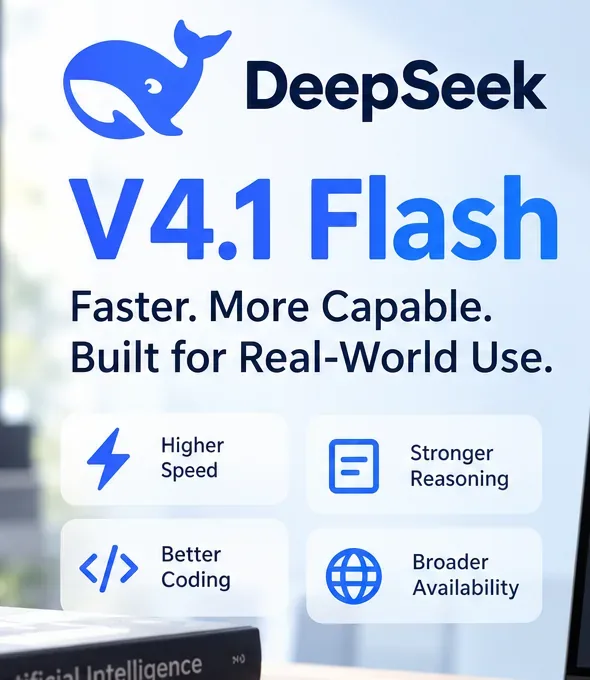
AI-generated illustration of the DeepSeek V4.1 Flash release; not an official DeepSeek interface or benchmark screenshot.
What is new in the architecture?
The most important architectural change is asymmetry between input processing and output generation. DeepSeek describes V4.1 Flash as a 552B-parameter Mixture-of-Experts backbone using a new Causal-Encoder-Decoder design. During prefill, only about 8B parameters are activated per token; during decoding, that rises to about 16B. That matters because an AI service can have a very large pool of learned parameters without paying the full compute cost of activating all of them for every token.
DeepSeek also adds an Engram component with 196B parameters. In practical terms, this is designed to move some memory-like lookup work away from the expensive core model path. The company says the new generation substantially reduces KV-cache requirements compared with the previous generation, cutting HBM requirements to about one-quarter and SSD requirements to about one-eighth in its stated comparison. These are vendor-reported architecture figures, not measurements from this article.
The release also uses a new pre-training approach and larger-scale reinforcement-learning post-training. DeepSeek presents the combination as the reason V4.1 Flash can raise its capability ceiling while improving inference speed and throughput. Developers should therefore avoid interpreting “Flash” as meaning “fewer total parameters than V4 Flash 0731.” The earlier V4 Flash family was documented at 284B total parameters with 13B active; V4.1 Flash is larger in total learned capacity but more selective about how much of that capacity is active during different phases of inference.
DeepSeek explicitly describes V4.1 Flash as natively multimodal with visual understanding. This is a more fundamental change than the August 2026 V4 Flash Vision Exp release, which was a separate experimental multimodal branch. The earlier Vision Exp documentation said that model matched V4 Flash's text abilities while adding mixed text-and-image input. With V4.1 Flash, visual understanding is part of the new model architecture rather than a separately named experimental vision route.
If your application sends screenshots, charts, UI captures, diagrams, or photographs, test the exact image payload format and token accounting you intend to use. DeepSeek's earlier vision documentation supported image input through its API, but launch-day routing changes mean you should verify the current V4.1 request schema against the live docs rather than assuming every Vision Exp detail carries forward unchanged. The older first-party reference remains useful for context: DeepSeek's V4 Flash Vision Exp release note.
Reasoning, coding, and agent work
DeepSeek's launch benchmark set shows the clearest gains in agentic coding and tool-oriented tasks. These are vendor-reported benchmark results, so they are best read as controlled comparison points rather than guarantees for your repository, tool stack, or latency target.
Benchmark
V4.1 Flash
V4 Pro 0813
V4 Flash 0731
Terminal-Bench 2.1
90.6
87.9
82.7
DeepSWE
74.2 on the V4.1 launch evaluation
62.7
54.4
NL2Repo
65.4
61.5
54.2
CyberGym
88.1
83.3
76.7
HLE with tools
63.9
60.0
51.5
Automation-Bench
54.8
31.8
25.1
The earlier comparison columns can be checked against DeepSeek's own model cards for DeepSeek V4 Pro 0813 and DeepSeek V4 Flash 0731. The V4.1 figures above are from DeepSeek's September 10 launch material. Benchmark versions and harness settings matter: do not compare scores from similarly named tests unless the task version and evaluation setup are aligned.
DeepSeek also reports a GPQA Diamond score of 90.9, a Codeforces rating of 3471, and additional results across Terminal-Bench 3.0 and 4.0, ProgramBench, security benchmarks, multimodal tool tasks, and general agent evaluations. For real deployment decisions, the most useful interpretation is not “V4.1 wins every task.” It is that DeepSeek is positioning Flash as capable enough to replace its previous Pro API tier in many production workloads while costing less to serve.
How is DeepSeek V4.1 Flash available?
DeepSeek API
V4.1 Flash is available through DeepSeek's API. DeepSeek instructs developers to use deepseek-flash for the latest V4.1 Flash model. The prior deepseek-v4-flash and deepseek-v4-flash-vision-exp names are being kept temporarily as compatibility routes that point to V4.1 Flash.
This routing behavior is important for reproducibility. If you keep an old API model string, the returned model behavior can change underneath your application. A test suite that passed against V4 Flash 0731 may therefore be exercising V4.1 Flash after the routing change. Record the actual serving model, request date, reasoning settings, and API route in benchmark logs.
V4 Pro transition
DeepSeek says V4 Pro will be phased out in an orderly transition. After 12:00 Beijing time on September 14, 2026, and until V4.1 Pro becomes available, requests sent to deepseek-v4-pro are scheduled to route to V4.1 Flash and be billed at the V4.1 Flash rate. Teams that require strict model identity should not treat the old Pro route as a permanent pinned checkpoint.
Open weights and self-hosting
DeepSeek's release material points to open model weights on its official Hugging Face account. That does not mean V4.1 Flash is a casual single-GPU local model. The published architecture is large, and DeepSeek's release note specifically discusses support for large-scale deployment and inference adaptation. Before planning hardware, read the current model card and technical report rather than relying on Hugging Face's automatically calculated parameter display, which can be misleading for architectures with separate Engram parameters and asymmetric activation.
What does V4.1 Flash cost?
DeepSeek changed Flash pricing at 12:00 Beijing time on September 10, 2026. The customer notice for the new schedule lists off-peak rates per one million tokens of CNY 0.02 for cache-hit input, CNY 1 for cache-miss input, and CNY 4 for output; peak rates are twice the off-peak rates. Pricing is especially relevant for long-running agents because repeated prefixes and cache hits can dominate the economics of multi-step workflows.
Because pricing is time-sensitive, do not hard-code these figures into a long-lived budgeting document without a date. Check the official DeepSeek Models & Pricing page immediately before deployment or procurement. During this launch-day verification, search indexing of the public pricing documentation lagged the customer notice, so the live account console should be treated as authoritative if the pages disagree.
DeepSeek V4.1 Flash vs. earlier DeepSeek models
Model
What it was designed for
Key distinction
Status after V4.1 launch
DeepSeek V4 Flash 0731
Fast, low-cost text reasoning and agents
284B total / 13B active in the V4 architecture; major agent post-training upgrade
Previous generation; API compatibility route is being redirected to V4.1 Flash
DeepSeek V4 Flash Vision Exp
Experimental multimodal agents
Added image input while matching V4 Flash text capabilities
Retired as a separate API model; compatibility name temporarily routes to V4.1 Flash
DeepSeek V4 Pro 0813
Higher-end reasoning and production agents
Larger V4 model with stronger official agent scores than Flash 0731
Scheduled to route to V4.1 Flash after September 14 at 12:00 Beijing time until V4.1 Pro launches
DeepSeek V4.1 Flash
High-throughput multimodal reasoning, coding, and agents
New Causal-Encoder-Decoder architecture, native vision, asymmetric 8B-prefill/16B-decode activation, Engram component
Current new Flash release
The practical change is that DeepSeek has collapsed what used to be a three-way choice—Flash for cost, Vision Exp for images, Pro for maximum capability—toward one V4.1 Flash model for a much larger share of use cases. That does not make V4.1 Flash automatically best for every workload. V4.1 Pro has not yet been released, and your own task distribution may expose regressions that public benchmarks do not capture.
Migration checklist for developers
Use the new model route deliberately: switch staging traffic to deepseek-flash instead of relying on an old alias to redirect silently.
Retest image workflows: verify image formats, request construction, error handling, and billing with the V4.1 route.
Retest tool use: run your actual tools, schemas, retries, and multi-turn agent loops rather than relying only on benchmark scores.
Measure end-to-end time: track time to first token, generation rate, tool latency, retries, and total task completion time. A cheaper per-token model can still cost more if it uses many more tokens or repeats work.
Check reasoning settings: compare the effort level you normally use. Earlier V4 APIs exposed multiple thinking-effort choices; confirm that your SDK maps them correctly to the current model.
Watch model identity: old Flash, Vision Exp, and soon Pro routes may be redirected. Store the model name returned by the service when possible.
Recalculate budget: apply the September 10 peak/off-peak price schedule and your real cache-hit rate.
Keep rollback tests: preserve representative prompts and expected outputs so a routing change is visible before it affects production users.
For self-hosting, read the model card first: do not estimate VRAM or storage from “8B active” alone; the full model and Engram data still need to be stored and served.
What is still uncertain or easy to misread?
First, “8B active during prefill” does not mean V4.1 Flash is an 8B model. DeepSeek reports a 552B backbone and a large Engram component. Active parameters describe compute routing, not total storage.
Second, benchmark gains do not establish identical gains for every production workload. DeepSeek's numbers are vendor-reported, and agent benchmarks can be sensitive to harness design, reasoning budget, tool definitions, timeouts, and retry policy. Run an A/B evaluation on your own repositories and tasks.
Third, launch-day documentation may be temporarily inconsistent across the public changelog, pricing page, signed-in API console, partner catalogs, and Hugging Face metadata. That is common during a rapid rollout, but it means developers should record the date and source when documenting limits or prices.
Finally, V4.1 Pro remains a future model. DeepSeek has announced the interim routing plan, but a release date, final pricing, and exact capability gap for V4.1 Pro should not be inferred from V4.1 Flash.
Bottom line
DeepSeek V4.1 Flash is a substantive architecture release rather than a simple dated checkpoint. It combines native visual understanding, asymmetric sparse activation, an Engram memory component, lower cache requirements, and much stronger vendor-reported agent results. For API users, the most immediate operational change is the new deepseek-flash route and the retirement or redirection of earlier V4 routes. For self-hosters, the open-weight release is important, but the model remains a large deployment target despite its low active-parameter counts.
The best next step is practical: move a representative slice of your workload to V4.1 Flash, measure correctness, token use, latency, tool reliability, and total task cost, then decide whether it can replace your current Flash, Vision Exp, or Pro path. Keep the official DeepSeek API change log, the official pricing page, and the new V4.1 Flash model repository as your primary references while the rollout settles.