หน้าแรก
» โดเมน
»
How to Measure LLM Response Quality Using Evals Frameworks
How to Measure LLM Response Quality Using Evals Frameworks
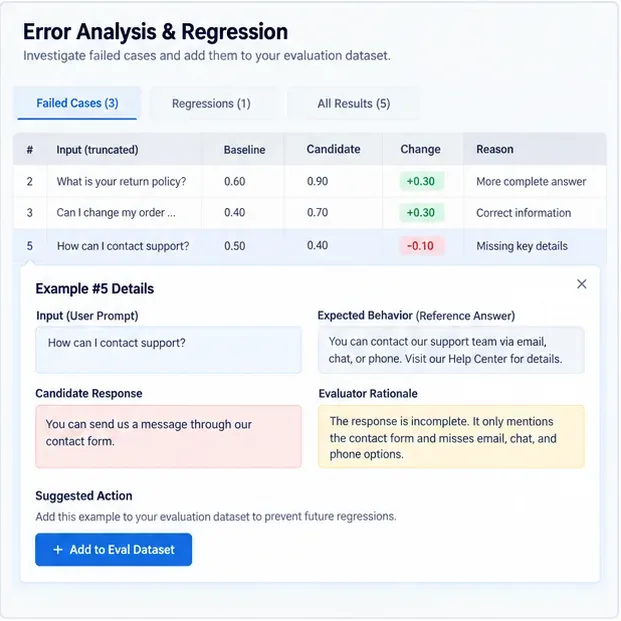
The most reliable way to measure LLM response quality is to treat evaluation as a repeatable test system, not as a single score. Define what “good” means for your application, build a representative evaluation dataset, combine deterministic checks with model-based and human judgment, compare every candidate change against a baseline, and inspect failures by category before you ship.
This matters because an LLM can produce an answer that sounds polished while still being wrong, unsupported, incomplete, unsafe, or inconsistent with your instructions. A useful eval framework turns those vague concerns into explicit criteria that can be rerun after a prompt change, model upgrade, retrieval change, tool update, or safety-policy revision.
Documentation note: the framework capabilities described below were checked against official documentation available on September 13, 2026. These tools evolve quickly, so verify current APIs before copying framework-specific code into production.
What should you measure first?
Start with the failure that would matter most to your users. For a factual support bot, correctness and policy compliance may dominate. For retrieval-augmented generation (RAG), groundedness and retrieval quality matter because a fluent answer can still invent facts that are not supported by retrieved context. For an agent, final-answer quality is not enough; you may also need to score tool selection, tool arguments, task completion, and unnecessary steps.
Quality dimension
What it asks
Good evaluator type
Correctness
Is the answer factually or logically right?
Reference comparison, code check, LLM judge, or human review
Instruction following
Did the model obey required constraints?
Code rules plus rubric-based judge
Groundedness
Are claims supported by the provided context?
RAG-specific judge or claim-level checks
Relevance
Does the response answer the actual question without drifting?
LLM judge or human review
Format compliance
Is the output valid JSON, schema-compliant, or otherwise machine-usable?
Deterministic code
Safety and policy
Does the answer violate your application rules?
Policy checks, LLM judge, and targeted human review
Efficiency
What latency, token use, and cost did the response require?
Telemetry and tracing
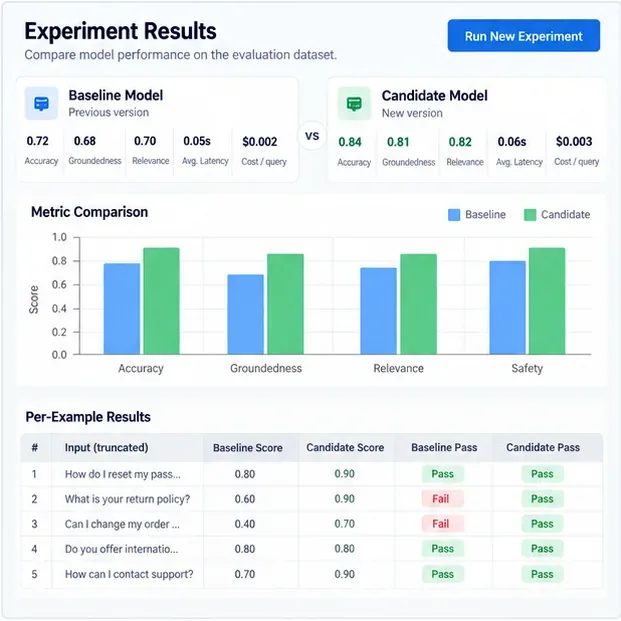
Do not average these into one number too early. A candidate model that gains two points in style but introduces even a small number of severe policy failures may be a worse release. Keep critical dimensions visible as separate gates.
A four-stage evaluation workflow that works across frameworks
1. Build a representative eval dataset
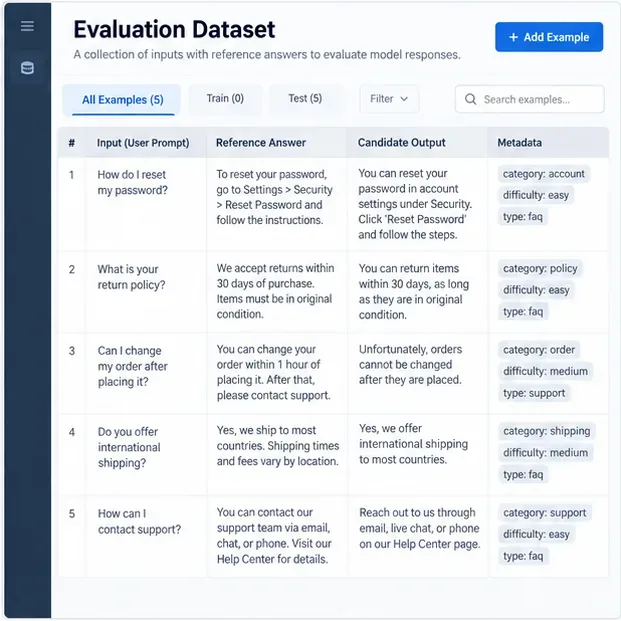
Your dataset should contain realistic inputs and, where possible, expected behavior. Some rows can have exact reference answers; others may need a rubric rather than a single “gold” sentence. Add metadata such as task type, customer segment, language, difficulty, retrieval condition, or safety category so you can later slice the results.
For example, imagine a customer-support assistant. A useful eval set would not contain only easy FAQ questions. It should also include ambiguous requests, policy exceptions, missing-context cases, adversarial prompts, multi-turn follow-ups, and examples where the correct behavior is to say that the answer cannot be determined.
LangSmith’s current evaluation guidance recommends beginning with manually curated examples that show what good behavior looks like, then expanding the dataset with historical traces and failures discovered in production. Its evaluation system supports datasets with inputs, optional reference outputs, and metadata. See the LangSmith evaluation concepts documentation.
An evaluation dataset should pair realistic prompts with references or expected behavior and preserve metadata for later failure analysis.
When this approach fits: almost always. Even if you use live production evaluation, you still need a stable offline set for regression testing. If you have no reference answer for open-ended tasks, store a rubric, required facts, prohibited behaviors, or pairwise preferences instead.
2. Match each quality dimension to the right evaluator
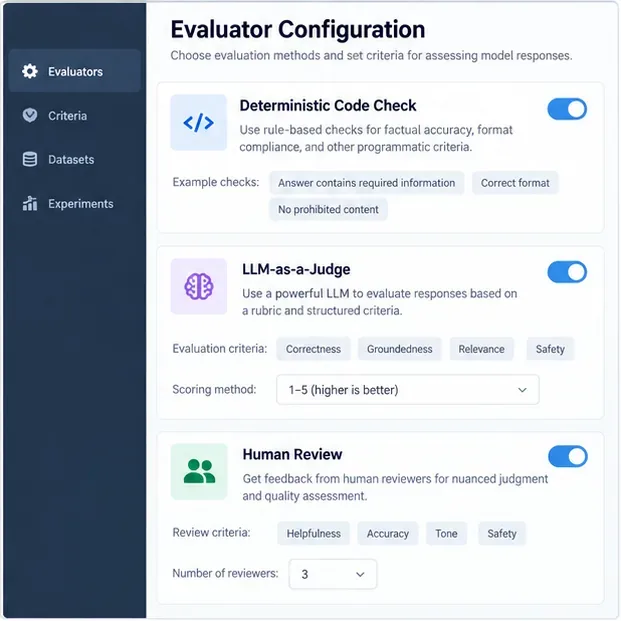
The strongest eval suites mix evaluator types because no single grader is ideal for every question.
Deterministic checks are best when the requirement is unambiguous: valid JSON, exact labels, required keys, numerical tolerance, regex rules, or whether a tool call used approved arguments.
Reference-based metrics can help when a known answer exists, but string similarity alone is often too brittle for valid paraphrases and too forgiving of semantically wrong text that shares vocabulary.
LLM-as-a-judge is useful for criteria such as completeness, relevance, tone, faithfulness, or whether an open-ended response satisfies a rubric.
Pairwise evaluation is useful when it is easier to decide whether candidate A or baseline B is better than to assign a meaningful absolute score.
Human review remains important for calibrating automated graders, resolving subjective or high-stakes cases, and checking whether the metric itself reflects user value.
API Evals ปัจจุบันของ OpenAI กำหนดการประเมินผลเป็นเกณฑ์การทดสอบบวกกับโครงสร้างข้อมูลแหล่งที่มา และรองรับตัวประเมินที่สามารถนำกลับมาใช้ใหม่ได้ API ตัวประเมินประกอบด้วยการตรวจสอบสตริงแบบกำหนดได้ ตัวประเมินความคล้ายคลึงของข้อความ และตัวประเมินตามแบบจำลอง ดูเอกสารอ้างอิง API Evals ของ OpenAIและเอกสารอ้างอิงตัวประเมินของ OpenAIบริการประเมิน AI Vertex AI Gen ของ Google Cloud รองรับเมตริกตามแบบจำลองแบบจุดต่อจุดและแบบคู่ รวมถึงเมตริกตามการคำนวณ ผลลัพธ์อาจรวมถึงคะแนนต่ออินสแตนซ์ คำอธิบาย ค่าเฉลี่ยรวม ค่าเบี่ยงเบนมาตรฐาน และอัตราการชนะแบบคู่ ดูเอกสาร ประกอบ ผลลัพธ์การประเมินของ Vertex AI