Home
» AI Agents
»
How to Measure LLM Response Quality Using Evals Frameworks
How to Measure LLM Response Quality Using Evals Frameworks
The most reliable way to measure LLM response quality is to treat evaluation as a repeatable test system, not as a single score. Define what “good” means for your application, build a representative evaluation dataset, combine deterministic checks with model-based and human judgment, compare every candidate change against a baseline, and inspect failures by category before you ship.
This matters because an LLM can produce an answer that sounds polished while still being wrong, unsupported, incomplete, unsafe, or inconsistent with your instructions. A useful eval framework turns those vague concerns into explicit criteria that can be rerun after a prompt change, model upgrade, retrieval change, tool update, or safety-policy revision.
Documentation note: the framework capabilities described below were checked against official documentation available on September 13, 2026. These tools evolve quickly, so verify current APIs before copying framework-specific code into production.
What should you measure first?
Start with the failure that would matter most to your users. For a factual support bot, correctness and policy compliance may dominate. For retrieval-augmented generation (RAG), groundedness and retrieval quality matter because a fluent answer can still invent facts that are not supported by retrieved context. For an agent, final-answer quality is not enough; you may also need to score tool selection, tool arguments, task completion, and unnecessary steps.
Quality dimension
What it asks
Good evaluator type
Correctness
Is the answer factually or logically right?
Reference comparison, code check, LLM judge, or human review
Instruction following
Did the model obey required constraints?
Code rules plus rubric-based judge
Groundedness
Are claims supported by the provided context?
RAG-specific judge or claim-level checks
Relevance
Does the response answer the actual question without drifting?
LLM judge or human review
Format compliance
Is the output valid JSON, schema-compliant, or otherwise machine-usable?
Deterministic code
Safety and policy
Does the answer violate your application rules?
Policy checks, LLM judge, and targeted human review
Efficiency
What latency, token use, and cost did the response require?
Telemetry and tracing
Do not average these into one number too early. A candidate model that gains two points in style but introduces even a small number of severe policy failures may be a worse release. Keep critical dimensions visible as separate gates.
A four-stage evaluation workflow that works across frameworks
1. Build a representative eval dataset
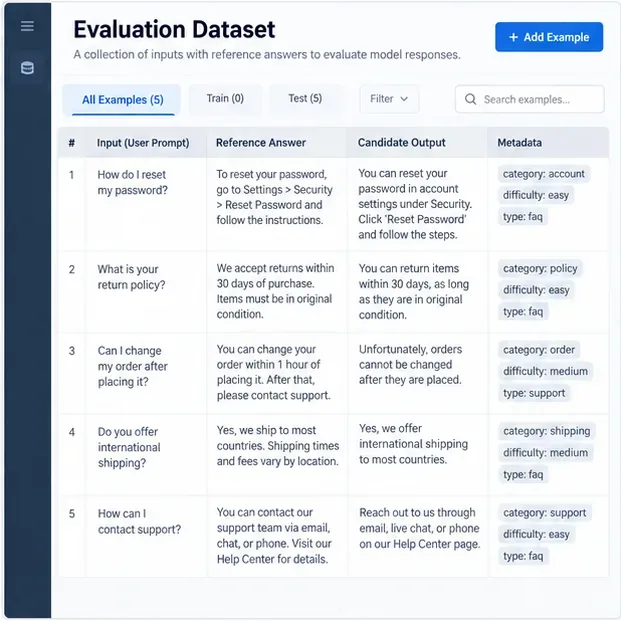
Your dataset should contain realistic inputs and, where possible, expected behavior. Some rows can have exact reference answers; others may need a rubric rather than a single “gold” sentence. Add metadata such as task type, customer segment, language, difficulty, retrieval condition, or safety category so you can later slice the results.
For example, imagine a customer-support assistant. A useful eval set would not contain only easy FAQ questions. It should also include ambiguous requests, policy exceptions, missing-context cases, adversarial prompts, multi-turn follow-ups, and examples where the correct behavior is to say that the answer cannot be determined.
LangSmith’s current evaluation guidance recommends beginning with manually curated examples that show what good behavior looks like, then expanding the dataset with historical traces and failures discovered in production. Its evaluation system supports datasets with inputs, optional reference outputs, and metadata. See the LangSmith evaluation concepts documentation.
An evaluation dataset should pair realistic prompts with references or expected behavior and preserve metadata for later failure analysis.
When this approach fits: almost always. Even if you use live production evaluation, you still need a stable offline set for regression testing. If you have no reference answer for open-ended tasks, store a rubric, required facts, prohibited behaviors, or pairwise preferences instead.
2. Match each quality dimension to the right evaluator
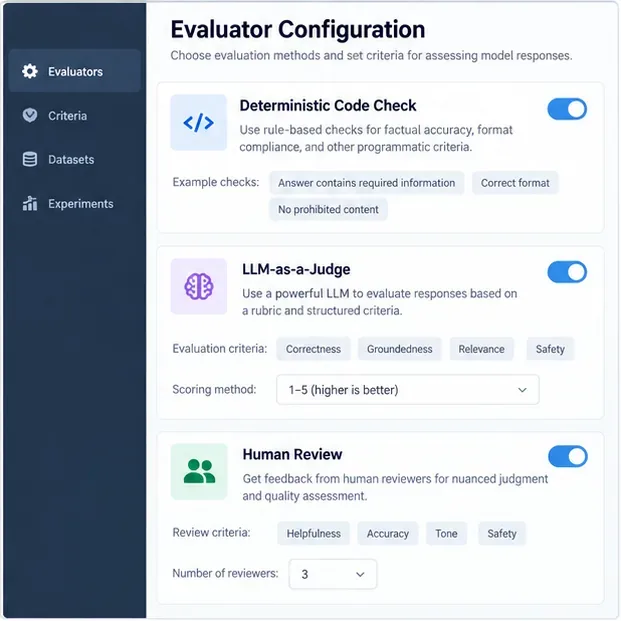
The strongest eval suites mix evaluator types because no single grader is ideal for every question.
Deterministic checks are best when the requirement is unambiguous: valid JSON, exact labels, required keys, numerical tolerance, regex rules, or whether a tool call used approved arguments.
Reference-based metrics can help when a known answer exists, but string similarity alone is often too brittle for valid paraphrases and too forgiving of semantically wrong text that shares vocabulary.
LLM-as-a-judge is useful for criteria such as completeness, relevance, tone, faithfulness, or whether an open-ended response satisfies a rubric.
Pairwise evaluation is useful when it is easier to decide whether candidate A or baseline B is better than to assign a meaningful absolute score.
Human review remains important for calibrating automated graders, resolving subjective or high-stakes cases, and checking whether the metric itself reflects user value.
OpenAI’s current Evals API defines an evaluation as testing criteria plus a data-source schema and supports reusable graders. Its grader API includes deterministic string checks, text-similarity graders, and model-based graders; see the OpenAI Evals API reference and OpenAI graders reference. Google Cloud’s Vertex AI Gen AI evaluation service supports pointwise and pairwise model-based metrics as well as computation-based metrics; its results can include per-instance scores, explanations, aggregate means, standard deviations, and pairwise win rates. See the Vertex AI evaluation results documentation.
Use deterministic rules where possible, add rubric-based LLM judges for semantic quality, and keep human review available for calibration and nuanced cases.
When this approach fits: use deterministic checks for machine-verifiable requirements, LLM judges for semantic qualities, and humans where disagreement has meaningful business or safety consequences. For a RAG system, Ragas exposes metrics such as context precision, context recall, response relevancy, and faithfulness, plus agent/tool-use metrics including tool-call accuracy and agent-goal accuracy. See the Ragas metrics documentation. DeepEval likewise provides task-specific metrics and custom LLM-judge evaluation, including G-Eval-style scoring; see the DeepEval metrics documentation.
3. Run the same dataset against a baseline and candidate
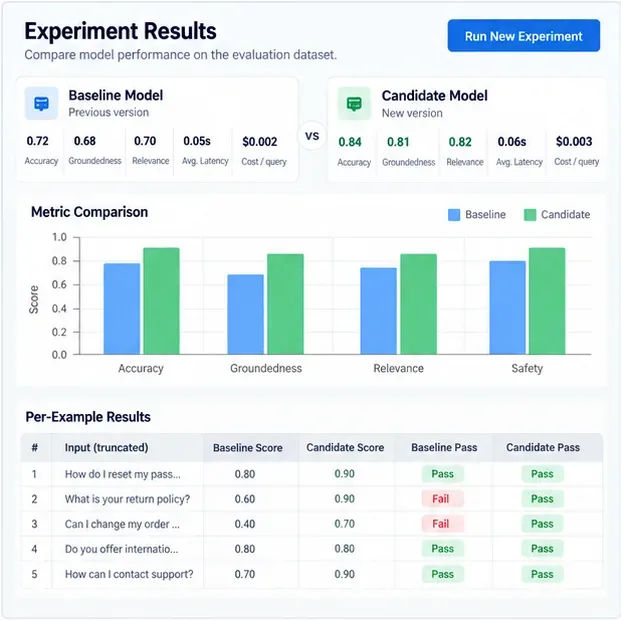
Absolute scores are useful, but release decisions are usually clearer when the new configuration is tested against the version you already trust. Keep the dataset, evaluator definitions, model parameters, and sampling settings as stable as possible. Then compare the same examples side by side.
Track at least three levels of results:
Per-example scores: Which exact prompts improved or regressed?
Per-slice results: Did performance change for long-context questions, a certain language, difficult cases, a product category, or adversarial inputs?
Aggregate results: What happened to pass rate, average score, latency, token usage, cost, and severe-failure counts?
For nondeterministic systems, rerun important tests enough times to understand variability rather than assuming one completion represents the model. If the release decision is material, use paired comparisons on the same examples and report uncertainty instead of relying only on a tiny change in the mean.
LangSmith supports offline experiments for comparing versions and pairwise evaluators, while MLflow’s current GenAI evaluation stack supports evaluation datasets, built-in and custom scorers, LLM judges, human feedback, tracing, and production monitoring. See LangSmith Evaluation and MLflow LLM and Agent Evaluation.
Compare a candidate with the current baseline on the same examples, then inspect both aggregate metrics and per-example pass or fail results.
When this approach fits: whenever you change a model, system prompt, retrieval pipeline, tool implementation, or decoding settings. A candidate should not be promoted merely because one aggregate metric rises; it should meet release thresholds on critical dimensions and avoid unacceptable slice-level regressions.
4. Inspect failures, calibrate the judge, and turn regressions into new tests
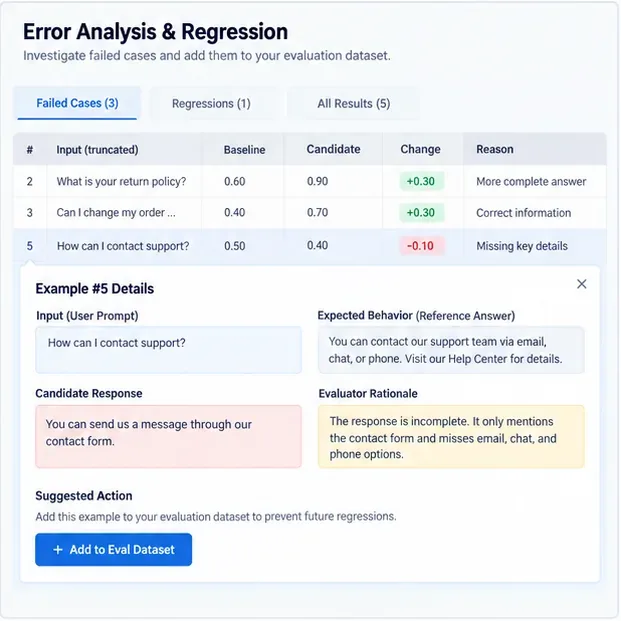
An eval run is valuable only if it changes what you do next. Sort failures by severity and root cause. A low groundedness score might come from weak retrieval, a prompt that encourages guessing, a judge rubric that is too vague, or an incorrect reference answer. Read the underlying examples before changing the model.
Then promote important failures into permanent regression cases. This creates a flywheel: production reveals a failure, a human confirms it, the case is added to the offline dataset, the fix is tested against the full suite, and future releases are blocked from reintroducing the same problem.
LLM judges also need evaluation. Google’s documentation explicitly describes comparing model-based metric outputs with human ratings to assess whether the judge is good enough for a particular use case. OpenAI’s GDPval work similarly uses expert pairwise grading as the primary standard and describes automated grading as an approximation rather than a replacement for expert judgment. See Vertex AI guidance on evaluating a judge model and OpenAI’s GDPval methodology.
Review the actual failed examples, confirm that the evaluator is judging correctly, and add important regressions to the permanent test set.
When this approach fits: always for high-impact errors and whenever an LLM judge influences a release gate. If human reviewers repeatedly disagree with the judge, fix the rubric, provide clearer references, change the judge model, or move that criterion back to human review.
How reliable is LLM-as-a-judge?
LLM judges are powerful because they can evaluate open-ended outputs at a scale that human-only review cannot match. The original G-Eval research reported substantially better correlation with human judgment than traditional automatic metrics on the summarization setting it studied. However, the same paper warned that LLM evaluators can favor LLM-generated text. See the original G-Eval paper.
Separate research on MT-Bench and Chatbot Arena found that strong LLM judges can align well with human preferences, while also documenting position, verbosity, self-enhancement, and reasoning-related biases. See the original LLM-as-a-judge study.
The practical conclusion is not “never use LLM judges.” It is: calibrate them. Build a human-labeled sample, measure agreement, inspect disagreement categories, randomize or swap answer order in pairwise tests when position effects are plausible, and avoid letting the same vague judge prompt silently determine every release decision.
Which eval framework should you choose?
Framework
Best fit
Notable strength
OpenAI Evals and graders
Teams already using OpenAI APIs and wanting API-native eval runs
Reusable eval definitions with deterministic and model-based graders
Strong experiment comparison and production feedback loop
Ragas
RAG pipelines and agent/tool-use evaluation
Purpose-built retrieval, faithfulness, relevance, and tool metrics
DeepEval
Python-centric teams that want test-style evals and customizable LLM judges
Broad metric catalog, component/end-to-end evaluation, and agent trajectory metrics
MLflow GenAI Evaluation
Teams that already use MLflow or want evals tied to tracing and lifecycle management
Datasets, scorers, human feedback, experiment tracking, and production monitoring
Vertex AI Gen AI Evaluation
Google Cloud deployments
Pointwise, pairwise, model-based, and computation-based evaluation workflows
Framework choice matters less than evaluation design. You can build a weak eval suite in a sophisticated platform or a strong one with a few scripts. Favor the tool that makes your tests reproducible, versioned, easy to inspect, and easy to run before every meaningful change.
A practical release scorecard
For a production assistant, a useful release decision can be expressed as a set of gates instead of one blended score. For example, require zero critical safety failures in the curated safety set, no statistically meaningful regression in task correctness, a minimum groundedness pass rate for RAG questions, valid structured output on every schema case, and latency or cost within your operational budget. The exact thresholds must come from your risk tolerance and user requirements; there is no universal percentage that makes an LLM “good enough.”
Also preserve the raw examples behind the score. If a release moves from 0.84 to 0.86, you still need to know which two cases changed and whether those changes matter. In practice, teams learn more from a small number of clearly categorized failures than from an impressive dashboard average with no traceability.
Common evaluation mistakes
Testing only happy paths: add ambiguity, edge cases, prompt injection attempts, missing context, and known historical failures.
Using exact match for open-ended answers: reserve exact match for outputs where exactness is truly required.
Trusting an LLM judge without calibration: compare it with human labels and review disagreements.
Optimizing the average while hiding severe failures: keep safety, policy, and other critical dimensions as explicit gates.
Changing the dataset during a model comparison: freeze the comparison set or version it so results remain interpretable.
Ignoring production drift: offline evals protect releases; online evaluation and sampled human review reveal new user behavior and new failure modes.
Bottom line
Measuring LLM response quality is an engineering discipline, not a vibe check. Start with a representative dataset, define task-specific quality dimensions, choose deterministic checks wherever the requirement can be computed, use LLM judges where semantic judgment is necessary, calibrate those judges with humans, and compare candidate changes against a stable baseline. Then turn every important real-world failure into a future regression test.
If you follow that loop, the eval framework becomes more than a reporting dashboard: it becomes the quality-control system that tells you whether a prompt, model, retrieval change, or agent update actually made the product better.