Home
» AI Agents
»
Printable One-Page Marketing Strategy Template for Local Businesses: Channels, Budget, and Metrics
Printable One-Page Marketing Strategy Template for Local Businesses: Channels, Budget, and Metrics
A useful local-business marketing strategy should be short enough to use every week, but specific enough to force real choices. A one-page plan does that well when it answers six questions: Who are we trying to reach? What do we want them to do? Why should they choose us? Which channels deserve our limited time and money? What will we do this week? How will we know whether it worked?
The tradeoff is simplicity. A one-page template is excellent for a neighborhood retailer, restaurant, salon, clinic, home-service company, studio, or other local business that needs a practical operating plan. It is not a substitute for a full market study, annual financial forecast, brand strategy, or campaign brief when those are genuinely needed. The U.S. Small Business Administration says marketing plans commonly cover a target market, competitive advantage, sales plan, goals, actions, and budget; this template compresses those decisions into a working page rather than trying to document everything. See the SBA business-management guidance and its marketing-planning resources.
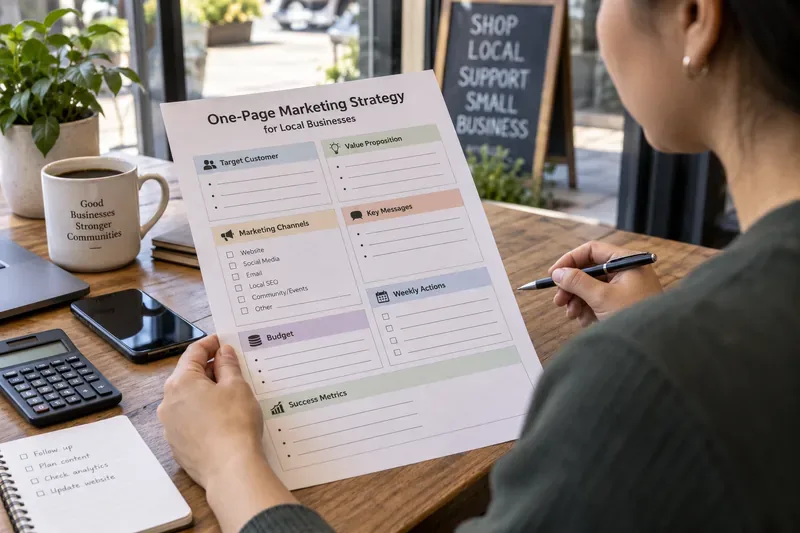
A one-page strategy works best when it keeps the target customer, channels, weekly actions, budget, and success metrics visible in one place.
Printable One-Page Marketing Strategy Template
Copy the table below into a document, fill it in, and print it for a weekly or monthly review. It is intentionally compact. Browser fonts and printer settings vary, so use print preview and adjust scale if you need it to fit on one physical sheet.
On __________, keep / change / stop based on the evidence.
Which Marketing Channel Should Be Primary?
There is no universal best channel for a local business. The better choice is the channel that matches customer intent, geography, buying cycle, budget, and your ability to measure the result. A channel that is inexpensive but never reaches people at the right moment can be more costly than a paid channel that reliably produces qualified leads.
Need
Strong candidate
Why it can fit
Main tradeoff
Useful metric
Be found when people actively search nearby
Google Business Profile
Connects the business to local Search and Maps discovery
Organic visibility is not something you can simply buy; proximity and competition matter
For local search, Google's current Business Profile guidance says local results are mainly based on relevance, distance, and prominence. Complete and accurate business information can help Google understand the business, but there is no paid shortcut to a better organic local ranking. Review the official Google Business Profile local-ranking guidance.
Google also documents Business Profile performance metrics such as views, searches, directions, calls, and website clicks, although not every metric applies to every business. Those are useful operational measures when your one-page plan focuses on local discovery. See Google's Business Profile performance documentation.
How to Choose Between Organic Visibility and Paid Reach
Choose organic local visibility when consistency matters more than speed
A well-maintained Business Profile is a sensible foundation for businesses that rely on nearby customers. The advantage is that the business can improve the quality and completeness of its presence without paying for every interaction. The limitation is control: a shop cannot choose how close it is to a searcher, and it cannot guarantee a ranking position.
Choose paid local search when timing and demand capture matter more than media cost
Paid search is more controllable because you can allocate budget, target queries and locations, and measure campaign actions. Google says location assets can show details such as an address, map information, or approximate travel distance, and can help users reach location pages, call, or get directions. That makes paid local search attractive for urgent or high-value services. The tradeoff is obvious: it costs money, and a click has little value if the landing page, call handling, availability, or offer is weak. Read Google Ads guidance on location assets.
Choose direct mail when neighborhood coverage matters more than precision
For businesses with a tightly defined service radius, physical mail can be worth testing alongside digital channels. The official USPS Every Door Direct Mail tool lets users select routes and filter by characteristics such as age, household size, and income. That is useful for neighborhood saturation, but it is still route-based targeting, not individual behavioral targeting. Printing, design, and postage also need to fit the budget. The USPS Every Door Direct Mail route tool shows the available route-selection workflow.
What Should Go in the Target Customer Box?
A target such as “everyone within five miles” is usually too broad to guide a message. Instead, write the smallest useful description that still represents enough potential demand. For a bakery, that might be “parents within a 10-minute drive who need custom birthday cakes with three to seven days' notice.” For an HVAC company, it might be “homeowners in three nearby ZIP codes with an urgent cooling problem.” For a B2B print shop, it could be “office managers at local firms that regularly need short-run event materials.”
Then check whether your assumption is grounded. The SBA recommends combining market research with competitive analysis to understand customers and identify a defensible advantage. Its planning resources discuss factors such as customer demand, market characteristics, competitor strengths and weaknesses, and barriers to entry. See the SBA planning and market-research resources.
How Specific Should the Value Proposition Be?
Specific enough to influence a choice. “Great service” is weak because competitors can say the same thing. Better statements connect a customer need with a meaningful difference: same-day repair appointments, certified specialization, late hours, curbside pickup, bilingual service, a particular product assortment, transparent fixed pricing, or a location advantage. Only use claims you can substantiate.
The tradeoff is breadth. A narrow promise is more memorable and easier to match with an ad or landing page, but it may exclude buyers who want something else. A broad promise reaches more people but often says less. For a one-page strategy, start with one high-priority segment and one believable reason to choose the business. Expand later only when the first message is working.
How Much Budget Should the Page Show?
Use two budgets: money and time. A “free” social-media plan can become expensive if it consumes ten owner-hours every week. A paid search campaign may look expensive in cash but efficient if it generates high-value calls and requires little staff time. Putting both limits on the page makes the tradeoff visible.
A practical budget line might read: “$600 per month in media, plus four staff hours per week.” The number itself should come from your economics, not from a generic industry percentage. Ask what a qualified lead or incremental customer is worth, how many can realistically be served, and what gross profit remains after fulfillment. If those numbers are not known, treat the first campaign as a controlled test rather than a promise of return.
Choose Metrics That Match the Goal
A local business can collect many numbers and still learn very little. Pick one primary outcome metric and a few diagnostic metrics. If the goal is appointments, booked appointments matter more than impressions. If the goal is store traffic, direction requests may be useful, but actual purchases are stronger when you can measure them. If the goal is phone leads, track qualified calls rather than total call-button clicks whenever possible.
Use a simple review rule: keep the channel if it is producing the desired outcome at an acceptable cost; change the offer, audience, message, or follow-up if activity is high but outcomes are weak; stop or reduce the channel if repeated tests still fail to produce evidence of value.
Email Can Be Efficient, but Compliance Is Part of the Strategy
Email is attractive because it can reach existing customers without paying for each impression or click. The tradeoff is responsibility. In the United States, the CAN-SPAM Act applies to commercial email and includes requirements around sender information, subject lines, postal addresses, opt-out mechanisms, and honoring opt-out requests. The Federal Trade Commission's CAN-SPAM compliance guide for businesses is the appropriate starting point. Businesses operating elsewhere should check the laws that apply to their customers and locations rather than assuming U.S. rules are sufficient.
Hypothetical Example: A Neighborhood Pet Groomer
Consider a hypothetical grooming shop whose problem is unused weekday capacity. The owner could fill the one-page template this way: target customers are dog owners within a 15-minute drive who can book weekday appointments; the primary goal is completed weekday bookings; the offer is a clearly defined weekday grooming package; the primary channel is Google Business Profile because customers often search locally; the support channel is email to existing customers; weekly actions are updating profile information and photos, sending one useful reminder or offer to the customer list, and asking satisfied customers for honest feedback without incentives that would distort reviews.
A different groomer might make a different choice. If it is newly opened and needs immediate visibility, paid local search may deserve the primary slot. If it serves a dense suburban neighborhood and has a strong introductory offer, a measured direct-mail test may be reasonable. If it already has a large customer list but poor rebooking, email and appointment reminders may be more efficient than buying more awareness. The template is valuable because it makes that decision explicit instead of automatically adding every available channel.
When a One-Page Plan Is Not Enough
Move beyond one page when the business has multiple locations with different markets, several customer segments with different buying journeys, a large media budget, regulated claims, complex attribution, franchise requirements, or a major launch that needs detailed creative, financial, and operational planning. In those cases, keep the one-page sheet as the executive operating summary and attach the deeper research or campaign plans behind it.
Five-Minute Review Before You Print
One audience: Can a staff member picture the customer you mean?
One primary outcome: Is the goal a business action rather than a vanity metric?
One primary channel: Does it fit how that customer actually discovers or chooses a local provider?
One support channel: Does it reinforce the main channel instead of duplicating effort?
A real budget: Did you include both cash and staff time?
Measurable actions: Can you count leads, bookings, orders, visits, calls, or another meaningful outcome?
A review date: Have you decided when you will keep, change, or stop the plan?
That is the core discipline of a one-page local marketing strategy: choose fewer things, connect them to a real customer decision, and review the result. The best template is not the one with the most boxes. It is the one your business can actually use to make the next marketing decision.
Source check: Official SBA, Google Business Profile, Google Ads, USPS, and FTC materials were reviewed in September 2026. Platform features and legal requirements can change, so verify the linked official documentation before acting on time-sensitive details.